How to Make a Sourdough Starter From Scratch for Absolute Beginners
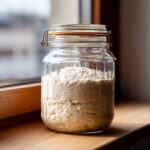
Learn the simple, step-by-step process to create your own active sourdough starter using only flour and water. This guide provides a clear feeding schedule to help you cultivate your natural yeast culture for homemade bread.
- Prep Time: 5 min
- Cook Time: 0 min
- Total Time: 7 days (active creation period)
- Yield: 1 active sourdough culture 1x
- Category: Baking Foundation
- Method: Natural Fermentation
- Cuisine: American Home Baking
- Diet: Vegan
Ingredients
Scale
- 100g Whole Wheat Flour or Rye Flour (for initial activation)
- 100g Unbleached All-Purpose Flour (for ongoing feeding)
- 100g Unchlorinated Water (room temperature)
Instructions
- Day 1: Mix 50g of whole wheat or rye flour with 50g of room temperature water in a clean glass jar. Stir until no dry flour remains. Cover loosely and leave at room temperature (68-75°F) for 24 hours.
- Day 2: You may see little to no activity. Discard half of the mixture (about 50g). Add 50g of all-purpose flour and 50g of water to the remaining starter. Mix well, cover loosely, and wait 24 hours.
- Day 3: You might see some bubbles or smell a sour/vinegary scent. This is normal. Discard half. Feed with 50g of all-purpose flour and 50g of water. Wait 24 hours.
- Day 4: Activity should increase. If you see significant bubbles, you can switch to feeding twice a day (every 12 hours) using a 1:1:1 ratio (e.g., 50g starter, 50g flour, 50g water). Discard half before each feeding.
- Day 5 – 7: Continue feeding twice daily using the 1:1:1 ratio with all-purpose flour and water. Look for consistent doubling in volume within 4-8 hours after feeding. The smell should become pleasantly tangy, not sharp or foul.
- Day 8+: When your sourdough starter consistently doubles in size after feeding and is full of bubbles (a bubbly sourdough starter), it is active and ready to use for baking. You can now transition to maintaining it or storing it in the refrigerator.
Notes
- Use unchlorinated water; chlorine can inhibit yeast growth.
- Maintain a consistent room temperature between 68 to 75 degrees Fahrenheit for best results when starting.
- If your starter seems sluggish, try switching back to whole wheat flour for a few feedings to boost activity.
- For long-term storage, feed your starter, let it peak, then place the jar in the refrigerator. Feed it once a week.
Nutrition
- Serving Size: N/A (Culture)
- Calories: 0
- Sugar: 0
- Sodium: 0
- Fat: 0
- Saturated Fat: 0
- Unsaturated Fat: 0
- Trans Fat: 0
- Carbohydrates: 0
- Fiber: 0
- Protein: 0
- Cholesterol: 0